
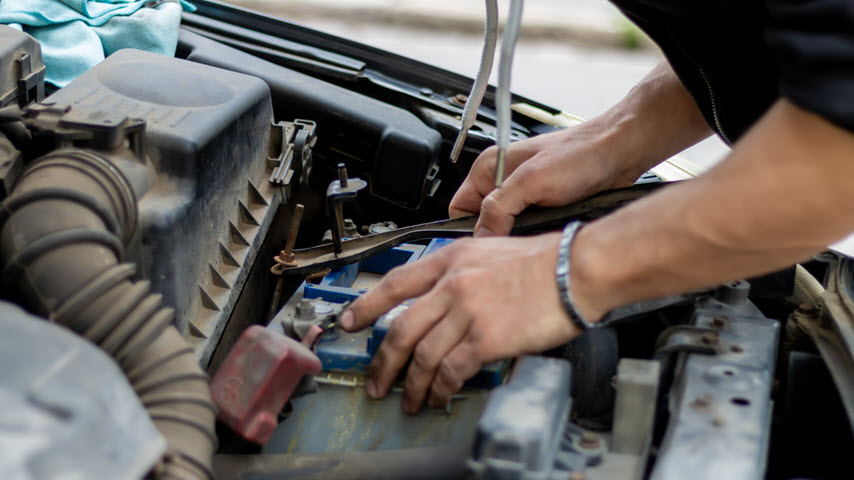
A weak battery can cause slow cranking and low-voltage faults, but similar symptoms can come from the charging system, starter, cables, grounds, electrical loads, or a battery that was discharged while parked. The right time to replace a battery is when testing and condition support that decision.
When a Sprinter Battery Should Be Tested
Slow or Intermittent Cranking
If the engine cranks more slowly than usual, note whether the symptom appears after the van sits, during cold weather, or after electrical equipment has been used. A state-of-charge and load test can distinguish a discharged battery from one that can no longer provide the required current. Starter-circuit voltage drop may also need checking.
Lights or Accessories Behave Differently
Flickering lights, modules resetting, slow power doors, or several unrelated warnings may occur when system voltage is unstable. These symptoms do not identify the battery by themselves. Alternator output, connections, grounds, wiring, and added equipment must also be considered.
Charging-System Warning
A battery-shaped warning while the engine runs commonly indicates a charging-system concern. The van may be operating on stored battery energy and could shut down once that energy is depleted. Arrange prompt diagnosis rather than assuming a new battery alone will fix the problem.
Case or Terminal Damage
Corrosion can increase resistance at a connection, while a cracked, leaking, swollen, or overheated case is a safety concern. Do not charge or handle a visibly damaged battery. Keep ignition sources away and arrange professional service.
Why Repeated Discharge Needs a Cause
Installing a battery without correcting the reason it went flat can lead to another no-start. Depending on the symptoms, testing may include:
- battery state of charge and capacity;
- alternator output under appropriate conditions;
- voltage drop across power and ground cables;
- starter current and operation;
- key-off or parasitic current after the vehicle enters sleep mode;
- added inverters, refrigeration, lifts, lights, chargers, or camper equipment;
- starter and auxiliary batteries on vehicles equipped with more than one battery.
Low voltage can set multiple fault codes. Those codes should be interpreted after the power-supply problem is corrected; they do not always mean every named system has failed.
Replacing the Correct Battery
The correct battery depends on the Sprinter’s model, equipment, location, size, capacity, terminal arrangement, technology, hold-down, and venting. A house or auxiliary battery is not a substitute for the starter battery, and carrying a loose battery inside the van creates serious short-circuit, movement, and venting risks.
The replacement procedure may include safe power disconnection, inspection and cleaning of connections, correct fastening, vent connection where equipped, and any model-specific reset or monitoring procedure. Charging and starting performance should be checked after installation.

Sprinter Battery Testing and Replacement in Norcross
At Sprinter Gurus, our certified technicians test the starting and charging system and explain whether the evidence supports charging, connection repair, further electrical diagnosis, or battery replacement.
Our only shop is at 6000 Jimmy Carter Blvd Suite 200, Norcross, GA 30071. Call us or request an appointment before a recurring slow crank becomes a no-start.