
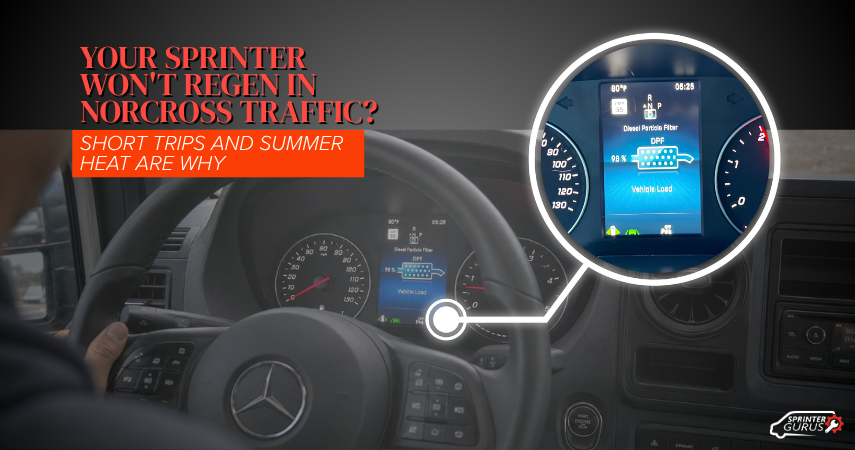
A Sprinter used for short delivery routes around Norcross may have fewer opportunities to complete automatic diesel particulate filter regeneration. Short trips and long idle periods can contribute to soot loading, but a DPF warning can also involve stored faults, temperature or pressure sensors, engine operation, or a filter that is already too heavily loaded.
The DPF and DEF/SCR systems perform different emissions functions. A fault in either system can trigger warnings or reduced-power strategies, depending on the model and fault. If DPF, DEF, or check-engine warnings repeat, schedule a diagnostic inspection instead of assuming a highway drive or fluid top-off will solve the cause.
Quick Summary: Key Takeaways
- Short-trip use matters: Repeated short trips and long idle periods can make automatic DPF cleaning more difficult.
- Warnings need diagnosis: Sensor, engine, DPF, DEF, or SCR faults can prevent normal regeneration or trigger reduced power.
- Use the correct DEF: Use sealed fluid that meets the required specification and avoid contamination.
- Do not force a generic drive cycle: Regeneration conditions and driver procedures vary by model year and equipment.
- Act before the filter is overloaded: Continued operation with warnings can increase soot loading and limit the available repair options.
How Sprinter DPF Regeneration Is Supposed to Work
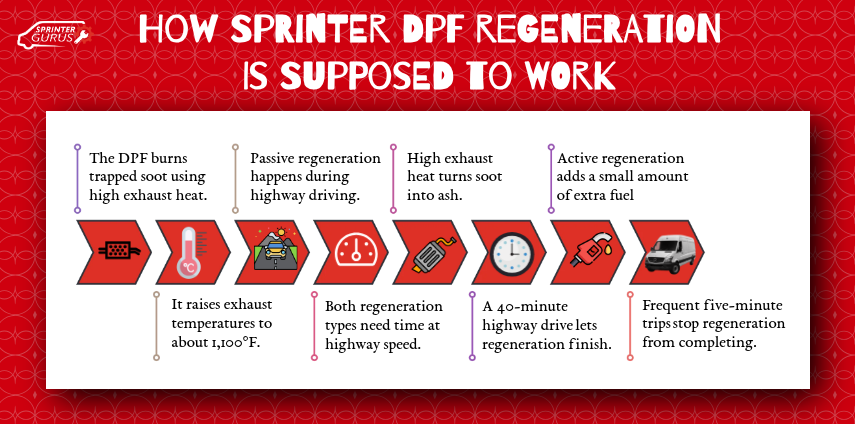
The DPF traps soot and the vehicle periodically raises exhaust temperature so the soot can be oxidized. The exact strategy, driver messages, and available manual-regeneration features vary by model year and equipment. Regeneration will not proceed unless the required operating and fault conditions are satisfied.
Mercedes-Benz owner manuals for some recent Sprinters describe an uninterrupted regeneration as taking approximately 20–25 minutes and note that predominantly short-distance use can interfere with automatic cleaning. That is model-specific guidance, not a guarantee that a set time on I-85 will clear every warning. Check the Mercedes-Benz manual for your model year and do not attempt a manual or stationary regeneration unless the vehicle is equipped for it and all listed safety conditions are met.
Why Short Norcross Routes Can Interrupt the Cycle
Repeated short trips, stop-and-go operation, and extended idling may prevent the exhaust and vehicle systems from meeting the conditions needed for automatic regeneration. However, route length alone does not diagnose the problem. Engine faults, exhaust-temperature or differential-pressure sensor faults, fuel-system concerns, or an overloaded filter can also interrupt regeneration.
Hot Georgia weather increases cooling-system and A/C demand, but ambient heat by itself does not prove why a DPF warning appeared. The stored faults, soot-load calculation, temperature data, and operating history need to be reviewed together.
Where DEF Fits In and Why Quality Matters
DEF supports the SCR system, which reduces nitrogen-oxide emissions after combustion. It does not directly clean soot from the DPF. Use sealed DEF that meets the required specification, keep dirt and other fluids out of the tank, and follow the vehicle’s warnings and owner-manual instructions.
A DEF warning can involve fluid level or quality, a pump, heater, injector, sensor, wiring, or another SCR-system fault. Topping off the tank will not correct every DEF warning, and replacing fluid should be based on contamination, storage history, testing, and model-specific guidance. Learn about Sprinter fluid inspection.
What Happens If You Keep Ignoring a Clogged DPF
Continuing to operate with an unresolved DPF warning can increase soot loading and may lead to reduced power or a repair procedure that is no longer permitted. The warning sequence and response differ by model and fault, so do not assume that every van will request a forced regeneration before a derate.
If the van is in reduced power, running poorly, overheating, showing multiple warnings, or the DPF warning persists, arrange diagnosis. A road drive is not an appropriate substitute when the manual or warning message calls for service.
How We Diagnose a Sprinter Regeneration Problem
Diagnosis may include stored fault codes, calculated soot load, DPF differential pressure, exhaust-temperature data, regeneration history, engine operation, DEF/SCR status, oil level, and a visual inspection. A scan result is the starting point; the cause still needs targeted testing.
A service regeneration should be performed only when the model supports it, all required conditions are met, and the soot load and faults make the procedure safe and appropriate. Otherwise the underlying fault, sensor, engine condition, or filter may need repair or further evaluation first.
Frequently Asked Questions
Q: Why won’t my Sprinter complete a regen?
A: Short trips and heavy idling can contribute, but they are not the only causes. Stored engine or emissions faults, temperature or pressure sensor problems, operating conditions, or a heavily loaded filter can also prevent regeneration. Read the warning message and diagnose stored faults before assuming a highway drive is the answer.
Q: Can I force a Sprinter DPF regeneration myself?
A: Some Sprinters offer a driver-initiated or stationary regeneration feature, while others do not. Follow the owner manual for the exact model and equipment. Regeneration creates very hot exhaust and must meet the listed safety and operating conditions. If warnings persist, the van is in reduced power, or the procedure is unavailable, arrange professional diagnosis rather than forcing a generic drive cycle.
Q: What happens if I use cheap or old DEF in my Sprinter?
A: Out-of-spec or contaminated DEF can trigger SCR faults. Use sealed fluid that meets the specification required by the vehicle, keep the filling equipment clean, and follow the storage and shelf-life instructions on the container. If contamination or age is uncertain, have the fluid and system evaluated instead of assuming every warning needs a simple top-off.
Get Your Sprinter’s Emissions System Sorted
Fighting a DPF light or a van stuck in reduced power? Bring your Sprinter in before continued soot loading limits the available repair options.
Hours: Monday–Friday, 8:30 AM – 5:00 PM
Website: fixsprinters.com