
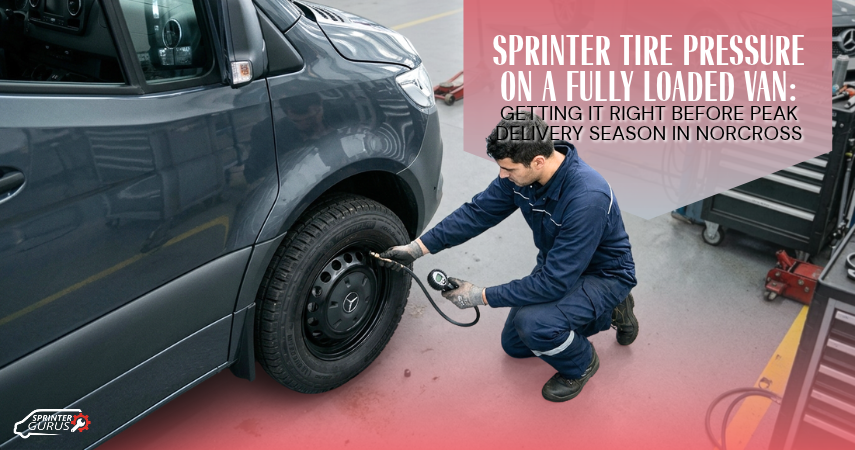
Most Sprinter tire pressure problems start with one habit: setting a van the same way all year, whether it runs empty or carries a full day of parcels. From November through the holidays, delivery and shuttle Sprinters around Norcross leave the lot loaded and stay that way until the last stop. Cold mornings arrive at the same time. Nobody feels a few psi through the steering wheel, and a tire that’s been running low under a full load can let go on I-85 with half the route still in the back.
Quick Summary: Key Takeaways
- The van’s label sets the number: pressure comes from the tire and loading label, not the maximum molded into the tire.
- Axles can differ: set front and rear to their own figures.
- Check cold: measure in the lot before the van leaves.
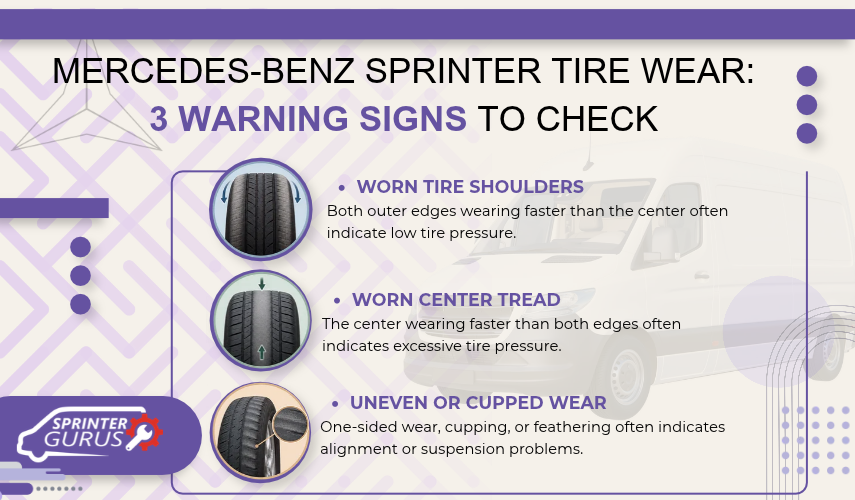
- Wear tells the story: worn shoulders mean low pressure, a worn center means too much, one worn edge means alignment.
- Some 2021 vans had a label recall: the weight rating on certain labels could be wrong.
Sprinter Tire Pressure Comes From the Label on the Van
The right Sprinter tire pressure is printed on the tire and loading information label, usually on the driver’s door edge or the pillar behind it. The figure on the tire’s sidewall is the most that tire can safely hold. It’s a ceiling.
Read the label first. Sprinters come in several weight ratings, with single or dual rear wheels and cargo or passenger bodies, so a cargo van and a 3500 dually running airport shuttles can carry different figures. The front axle often runs a different pressure from the rear. No single number fits every Sprinter, and the best tires for a Sprinter van are the ones whose load rating matches what its label calls for.
A Full Load Makes Low Pressure Far More Expensive
Low pressure costs a loaded van much more than an empty one. Every pound of cargo bears down on the same contact patches, so a tire short of air flexes harder, runs hotter and loses its shoulders early.
Weight ratings matter too. In 2022, Daimler Vans USA recalled 2,564 model-year 2021 Sprinters because the gross vehicle weight rating on the tire and loading label could be stated wrong, and NHTSA’s summary of recall 22V073 warns that an operator could overload the van, wearing the tires excessively and raising the risk of a crash. Run a 2021’s VIN.
Overloading shows underneath. Sagging rear springs and tired shocks change how the tread meets the road, so uneven wear can be a suspension problem.
Check Pressure Cold, Before the First Delivery
Read pressure cold, before the van moves, not after the morning loop through Peachtree Corners. Driving warms the air in each tire and pushes the reading up, so a tire that’s short when cold can look fine by lunch.
Colder nights make it worse. A van parked outside through a November night in Gwinnett starts the day lower than it finished, and the drop hits every van in the yard at once. So check in the lot at the start of the shift, and never let air out of a warm tire to match the label, because it’ll come up short once it cools.
Tread Wear Shows Which Way Pressure Has Been Wrong
A tire’s wear pattern records how it has been inflated. Worn shoulders with a healthy center mean it ran low, while a center strip wearing faster than both edges means it has been carrying more air than the label asks for. Read both.
One-sided wear is different. When only the inner or outer edge goes, or the tread shows cupping or feathering, alignment is the likelier cause. On a fleet, compare the same corner across several vans, because a pattern on every right-rear tire says more about the route or the loading than about one tire.
Dual Rear Wheels Share the Load Only at Equal Pressure
A dual-rear-wheel Sprinter carries each rear corner on two tires, and they split that weight evenly only when both hold the same pressure. Duals have to match. When one runs low, its partner takes more of the corner’s load on every loaded mile, so the pair wears faster and runs hotter than either would alone.
The low one is usually the inner tire, simply because its valve sits behind the outer wheel. Put the inner duals on the weekly list through the peak, and keep rotations on schedule, since tire rotation and wheel alignment both sit on the Sprinter factory maintenance list.
A Sprinter-Only Shop Covers the Tire Work and the Fleet Plan
Sprinter Gurus works on Mercedes-Benz Sprinters and nothing else. Its tire services cover installing new Sprinter van tires, rotation, balancing, flat repair and alignment, and the basic Sprinter service already includes tire checks alongside the oil and filter change, the brake inspection and the fluid levels.
Fleets can go further. Businesses running several vans can ask for a customized maintenance plan that keeps the whole fleet organized, so each van gets looked after on a set rhythm instead of waiting for a tire to complain. From Jimmy Carter Boulevard, Duluth is about 7.5 road miles away and Johns Creek about 8.8.
Frequently Asked Questions
Q: Where is the tire pressure label on a Mercedes Sprinter?
A: Open the driver’s door and look at the door edge or the pillar behind it. The label lists cold pressures for each axle, and the owner’s manual carries the same information if the label is unreadable.
Q: Should Sprinter tire pressure be higher when the van is loaded?
A: Follow your van’s label. If the label or manual gives separate figures for different loads, use the loaded figure on a van that runs full, and never exceed the maximum on the sidewall.
Q: How often should you check tire pressure on a delivery van?
A: Sprinter Gurus’ own guidance is once a month and before any long trip. Through the holiday peak, a weekly cold check before the van leaves the lot is worth the time.
Book a Sprinter Tire Check in Norcross
Start with the fullest vans. They’re where low pressure costs the most, and their tread usually shows whether the rest of the fleet needs the same attention. For the shop at 6000 Jimmy Carter Blvd, Suite 200, Norcross, GA 30071, the free quote form on fixsprinters.com asks for the van, its plate number, its rough mileage and what you want quoted.