
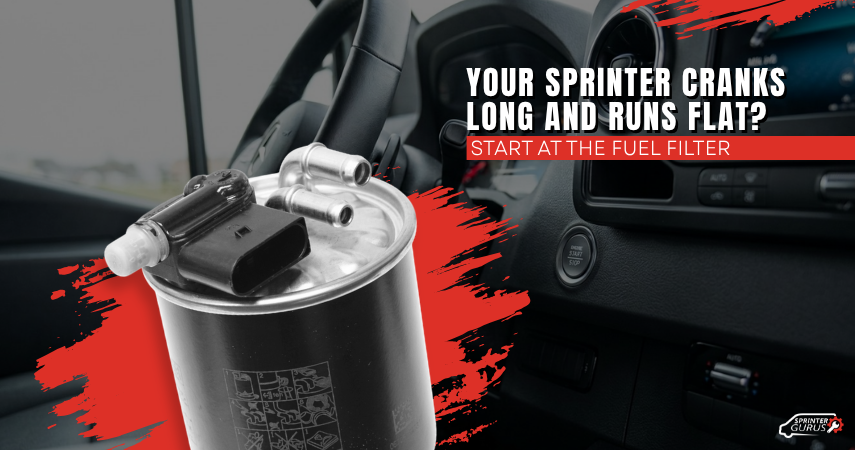
Cold morning on Jimmy Carter Boulevard, key on, and the van turns over for four seconds before it catches. It ran fine in July. No warning light, nothing on the dash to point at. That hesitation is usually the first thing a Sprinter says out loud about its fuel system, and it almost always traces back to a loaded fuel filter or water sitting in the separator bowl.
October is the month to deal with it. Norcross mornings drop into the forties, diesel thickens up, and water that was a slow nuisance in August becomes a van stranded in a Duluth parking lot at 6 a.m. Sprinter Gurus works on Mercedes-Benz Sprinter vans and nothing else, so the fuel filter on your OM642 or OM651 is a job the bays here see every week.
Quick Summary: Key Takeaways
- The filter is maintenance, not repair: the Sprinter fuel filter sits on the factory service schedule, and skipping one is how a four-figure injector bill starts.
- Water is the part that does damage: the separator collects condensation, and any water that gets past it wears the high-pressure pump from the inside out.
- Long cranks come first: a four-second crank on a cold morning and a soft spot merging onto I-85 are early symptoms, not van personality.
- Cold weather exposes a marginal element: thicker fuel plus a partly plugged filter is the combination that leaves vans sitting in October and November.
- Priming is the hard part: the system has to be bled properly after the change, or you spend a week chasing air and rough starts.
The fuel filter does two jobs and only one of them is filtering
That housing does double duty. It holds the filter element, and it holds a water separator that drops condensation out of the fuel before it reaches the injection pump — which matters far more on a diesel than most owners realize.
Diesel is the lubricant. On an OM642 V6 or the four-cylinder OM651, common-rail pressure runs north of 20,000 psi, and the moving parts inside the pump and injectors are fitted to clearances measured in microns. Anything abrasive or watery in the tank goes through the system as wear.
Which is why the cheapest part on the van protects the most expensive ones.
Water in the fuel is what destroys injectors and pumps
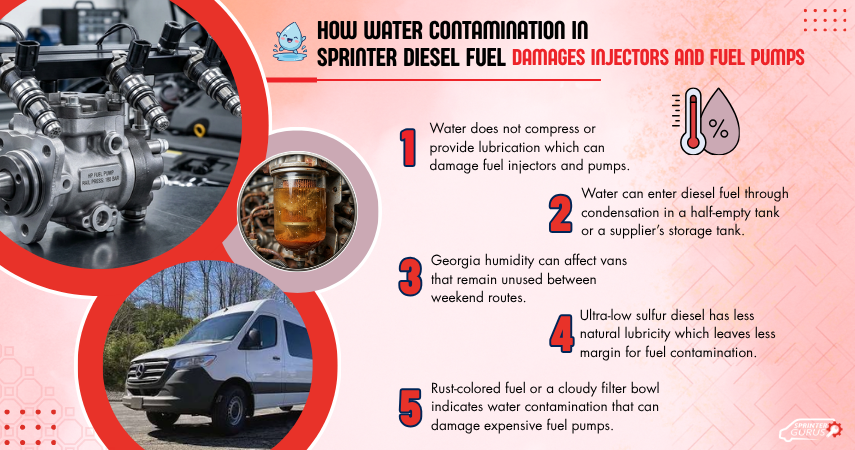
Water does not compress and it does not lubricate. It gets in from condensation in a half-empty tank, from a fuel supplier’s storage tank, and from Georgia humidity working on a van that sits between routes on the weekend.
Modern fuel is thinner than it used to be. Since 2010 every gallon of highway diesel sold in the U.S. has to be ultra-low sulfur, capped at 15 parts per million — a good thing for emissions, and a change that took some natural lubricity out of the fuel along the way. That leaves less margin for contamination, not more.
Rust-colored fuel in the drained bowl is a bad sign. So is a bowl that comes out cloudy instead of clear amber, because that haze is emulsified water on its way to a pump that costs many times what the filter does.
Cold mornings turn a marginal filter into a no-start
Diesel gels. As temperature drops, paraffin wax in the fuel starts forming crystals, and those crystals collect on the one surface designed to catch small things — the filter element you have been meaning to change.
Atlanta is not Minnesota, but it gets cold enough. NOAA’s 1991-2020 normals put the January low at Hartsfield-Jackson at 35.6 degrees, and any water already sitting in a separator bowl is ice at that temperature. A filter with 15,000 miles on it will usually still pass fuel in September and quit on the first 34-degree morning in December, which is why this job belongs on the calendar now.
Drain the bowl before then. It takes two minutes.
The symptoms owners describe before the tow truck shows up
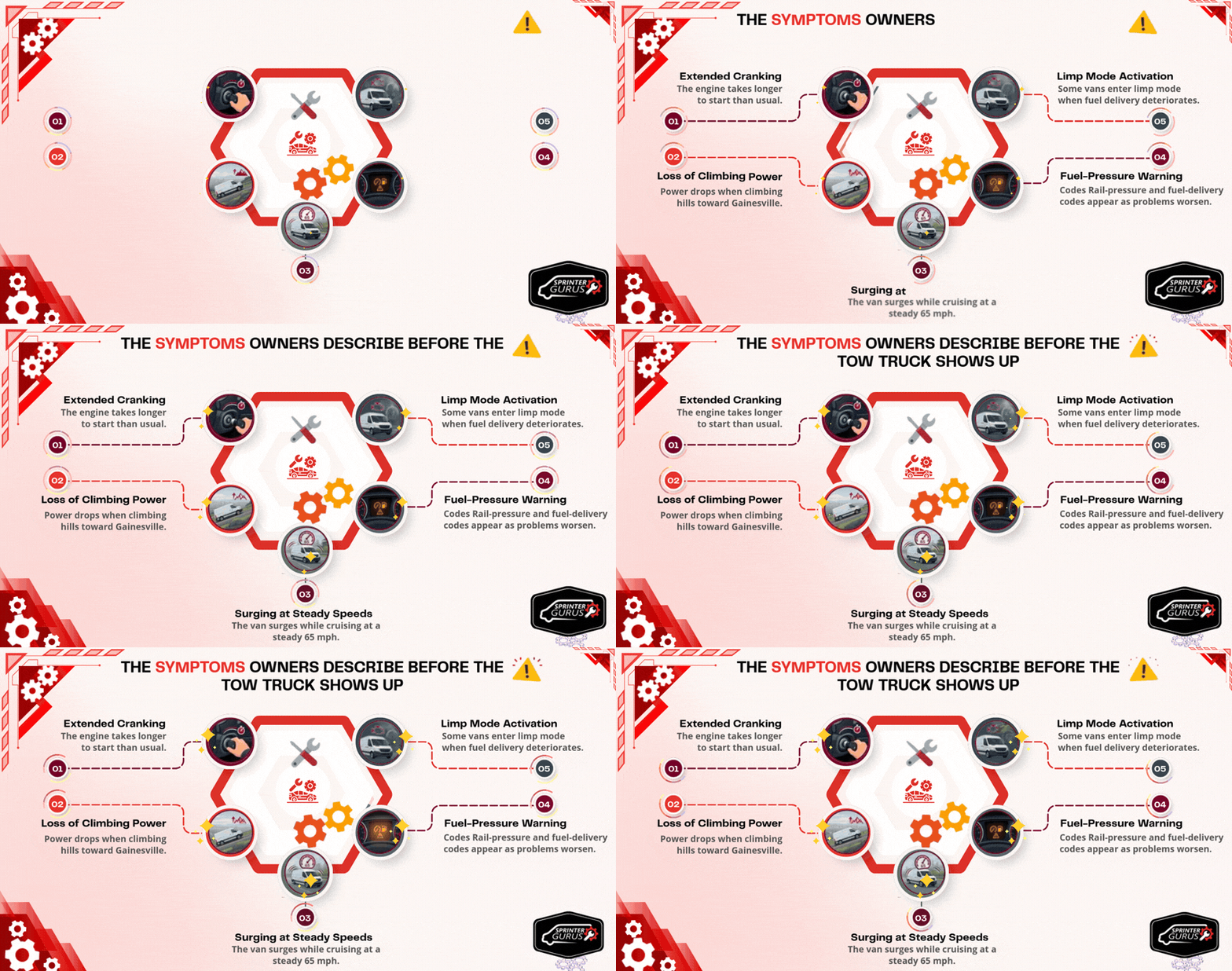
Extended cranking is the headline complaint, and it tends to arrive with company. Power falls off climbing the grades on I-985 toward Gainesville. The van surges at a steady 65. Under a load it feels like somebody is easing off the throttle for you.
Then the light comes on. Rail-pressure and fuel-delivery codes are common once the element is far enough gone, and some vans drop into limp mode rather than let you keep asking for boost. Do not clear the code and keep driving — a starved pump is a pump wearing out, and the repair grows every week you postpone it.
Doing it right is about priming, not about the part
The element is inexpensive. The skill is in what happens after it goes in: getting fuel back to the injectors without leaving air in the rail, and without cranking the starter for 30 seconds trying to make it happen.
Location varies by engine, and so does the procedure. Seals and O-rings get replaced rather than reused, the cap gets torqued to spec instead of muscled down, and a cross-threaded housing means diesel dripping onto a hot turbo — which is the actual reason we would rather you did not do this one in the driveway.
Norcross fleets get a shop that sees nothing but Sprinters
Sprinters only. We are on Jimmy Carter Boulevard just off Interstate 85, and the vans in the bays are shuttle vans, ambulances, delivery fleets and camper conversions from Alpharetta, Roswell, Duluth and Lawrenceville.
That narrow focus is why fuel complaints get diagnosed with data. We look at actual rail pressure against commanded pressure, at injector correction values, and at what the drained separator has to show us before anybody sells you a pump.
Frequently Asked Questions
Q: How often should a Sprinter fuel filter be replaced?
A: Go by the Mercedes-Benz maintenance schedule for your model year and engine — the fuel filter is a listed service item there, not an as-needed part. Vans that idle for hours or fill at high-turnover truck stops earn an earlier change than the book calls for.
Q: Can water in diesel fuel damage a Sprinter engine?
A: Yes, and it is the expensive way to learn the lesson. Water does not lubricate the high-pressure pump or the injector internals, and it corrodes the precision surfaces inside both. Draining the separator is a two-minute job that protects parts costing well over a thousand dollars.
Q: Why does my Sprinter crank a long time before starting?
A: A restricted fuel filter, water in the separator, or air drawn in through a loose fitting are the three usual causes. Glow plugs and battery condition matter too, which is why the diagnosis starts with fuel pressure data rather than parts.
Q: Is it safe to drive a Sprinter with a clogged fuel filter?
A: Not for long. The van may keep running, but the lift pump and high-pressure pump are working harder to pull fuel through a plugged element, and that effort is measured in wear. If the van has gone into limp mode, park it.
Book the fuel filter service before the first real cold snap
Bring the van in for the morning and we will change the filter, drain and inspect the separator, and read the fuel-system data so you know what the injectors are doing.
Sprinter Gurus — 6000 Jimmy Carter Blvd, Suite 200, Norcross, GA 30071
Hours: Mon-Fri 8:30 AM-5:00 PM; Sat-Sun closed
Website: fixsprinters.com