

Build finished, cooler packed, and the plan is to be north of Asheville by dinner with the leaves already turning. Add a full water tank, a battery bank and four people and the van weighs thousands of pounds more than it did leaving the factory, and every system feels that on the climb toward Mount Mitchell.
Ten thousand pounds changes the rules, and October on the Blue Ridge Parkway means long descents in low gear. Sprinter Gurus works on nothing but Mercedes-Benz Sprinters here in Norcross, so here’s the pre-trip list we actually run.
Quick Summary: Key Takeaways
- Check the door placard: Sprinter tires need the pressure printed on the B-pillar sticker, often 60 psi or more, not car-level pressure.
- Inspect the inner dual: on a 3500 dual rear wheel van the hidden inside tire fails first, and nobody sees it until it comes apart.
- Weigh the van loaded: a public scale tells you whether your conversion is over its 11,030 pound rating before a highway patrol does.
- Brakes carry the load: heavy vans eat pads and rotors early, and brake fluid needs replacing on Mercedes intervals regardless of mileage.
- Cooling comes first: a marginal radiator, fan clutch or coolant hose fails on the climb, not on the flat run out of Atlanta.
Tires and pressure matter more on a Sprinter than on any car
Start at the door jamb. That placard on the B-pillar gives cold pressures for your exact van and axle loads, and those numbers commonly run 60 psi or higher on load range E tires, nothing like what your car takes.
Then check the dates. A four-digit code on the sidewall tells you the week and year the tire was built, and van tires often age out before they wear out, especially on a camper that sits. Cold mornings shift the numbers, since pressure falls about 1 psi per 10-degree drop — 60 psi set in Norcross reads low at 40 degrees and 4,000 feet. Dual rear wheels need a gauge, not a boot. Inside tires are the ones that let go.
Brakes and suspension carry every pound you added
A loaded van stops like a truck. Pads and rotors wear faster than the interval suggests, and a van that felt fine empty around Norcross will feel long and soft coming down a mountain grade with 2,000 pounds of build behind you.
Suspension deserves a look too. Rear leaf springs sag under a permanent load, shocks fade, and a conversion that carries weight behind the axle needs an alignment check because the geometry changed the day the cabinets went in. Brake fluid ages on time, not mileage. Two years is the number.
Cooling still decides the climb, and the heater decides the mornings
Heat is the enemy on a loaded van. The OM642 and OM651 diesels work hard on a 6 percent grade even at 70 degrees, and a radiator half blocked with a summer’s worth of bugs, a tired fan clutch or a hose gone soft will pick that exact moment to quit.
Cabin comfort is a real system. Rear evaporators, blower motors and cabin filters all matter on a passenger van, and by October you need the other half of it as well: a heater core that actually heats and a defroster that clears the windshield at 38 degrees. Test both before you pack. Not after.
Weight and packing change how the van drives and drinks fuel
Weigh it loaded. A public scale tells you whether the 3500 rating of 11,030 pounds still holds once water, batteries and gear are on board, and guessing at payload is how people end up over the limit. Packing costs fuel as well, since the Department of Energy’s fuel economy site notes that an extra 100 pounds could reduce your mpg by about 1 percent. Roof cargo boxes cut highway fuel economy by 6 to 17 percent.
Balance matters too. Put the heavy items low and between the axles, keep the roof rack light, and make sure the spare and the jack are still reachable after the build. Plenty of conversions bury both under a bed platform.
A pre-trip service visit covers what a walkaround cannot
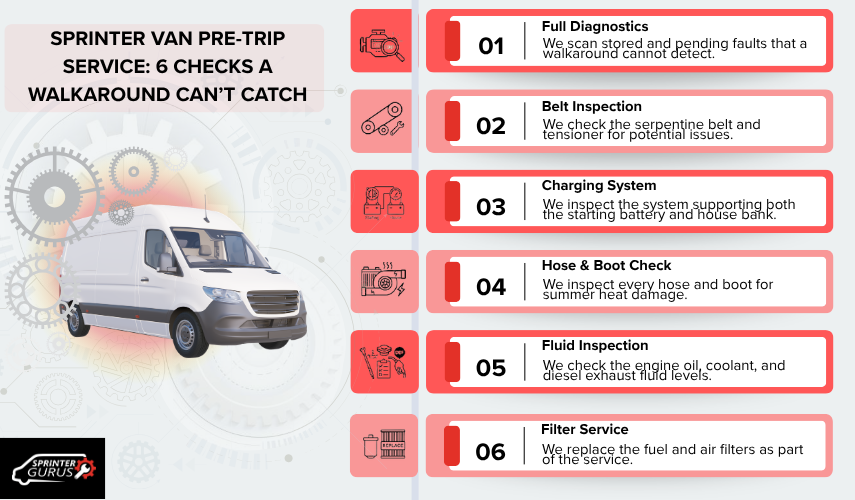
Some checks need a lift and a scan tool. We pull stored and pending faults, read fluid condition, check the serpentine belt and tensioner, inspect the charging system that keeps both your starting battery and your house bank alive, and look at every hose and boot for a summer’s worth of heat damage.
Fluids and filters come next. Engine oil on the Mercedes interval, fuel filter, air filter, coolant condition and a look at the diesel exhaust fluid level, all handled at once so the van leaves ready. One visit. One list.
Norcross van owners get a shop that works on Sprinters only
Sprinters only. We’re on Jimmy Carter Boulevard in Norcross, just off Interstate 85, and every bay in the building is set up for the height and the weight of these vans rather than for sedans.
That focus shows up in the details. Fleet operators, ambulance services and camper owners from Alpharetta, Roswell, Duluth, Dunwoody and Sandy Springs all use us, and a shop that sees the same OM642 problems weekly finds them faster than a general repair garage will.
Frequently Asked Questions
Q: What should I check on a Sprinter before a road trip?
A: Tire pressure against the door placard, tire age and the inside dual, brakes and brake fluid, coolant and hoses, air conditioning, belt and tensioner, fluid levels, and the loaded weight of the van.
Q: What tire pressure does a Sprinter van need?
A: Whatever the placard on the B-pillar lists for your model and axle, often 60 psi or higher, and front and rear pressures usually differ. Set them cold and check them again after the van is loaded.
Q: How often should Sprinter brake fluid be changed?
A: About every two years on Mercedes intervals, regardless of mileage. Fluid absorbs moisture over time, and a heavy van on a long descent is the worst place to find out yours is old.
Q: How much weight can a Sprinter 3500 carry?
A: Gross vehicle weight rating on a 3500 is 11,030 pounds, and your payload is that number minus the weight of the van and the conversion. One trip to a public scale is the only honest way to know.
Book the pre-trip inspection before you load the van
Give us the van for a day and we’ll go through tires, brakes, cooling and fluids so nothing surprises you on I-40 or the Parkway. Use the contact page to pick a date.
Hours: Mon-Fri 8:30 AM-5:00 PM; Sat-Sun closed
Website: fixsprinters.com